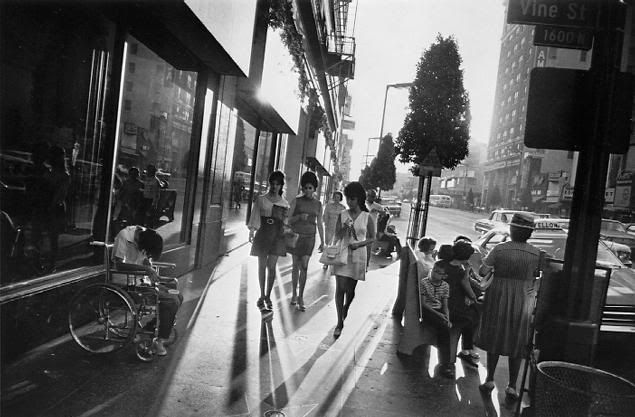
1) Standing in line outside Fred Meyer from 6:30 to 7:15 this morning in order to enter a raffle just to get a chance to purchase a Nintendo Wii. Do you think if I'd have got one, I'd feel less stupid? I doubt it.
2) A holiday tradition that's unintentionally been established over the past ten years is that I spend the first day after school ends (whether as a student or an instructor), trying to make a photo for a Christmas or New Year's card. Whether or not I actually getting around to making the card, I always make a picture or two. A recent post by Meland this photo by Colin have me excited to get to it... in fact, I think I'm going to make myself finish my grading today so I can get out there. Damn, this one's handsome, isn't it?
Colin Blakely, "The Seeming Impenetrability of the Space Between"
3) As a child, I remember a large door poster at my grandmother's house, proclaiming that "Jesus is the reason for the season!" a slogan that I developed into a little jingle that to this day, I have a hard time shaking once it enters my head. Since receiving this in my inbox this morning, I've been humming that jingle all morning:
Miguel and Matt have chimed in with more on the notion of "personal style" and yet again, I agree wholeheartedly. The distinction should be made between "personal style" as it refers to an artist's individual personality and concerns rather than their particular stylistic approach to the medium (But of course, in many ways, the two are tied… but I'll deal with that some other time). My point is simply that far too often the misguided approach to dealing with the larger, nagging question of "who am I?" as an artist is to choose a specific subject (or aesthetic gimmick) and repeat until there are enough images to fill a book or a site or gallery. Complex questions have no simple one-subject answers.
Though I sure do like birds.
I think this where we all start with photography... with an inventory of things we like. A couple years ago I handed my son a camera for the first time and watched as he walked around the house and took stock of the things that mattered to him, those things worthy of saving, cherishing, paying homage to, in a photograph... his younger brother, the cat, his Yu-Gi-Oh cards. There's nothing wrong with this, but in a sense, this is the most basic level to use the language of photography. I guess the trick is honing in and using the language to ask questions rather than inventory favorites. Or at least to find more than one favorite thing.
Of course, there are many exceptions to my ranting about solely subject-driven projects. When done well, with consistency and insight, tight constraints can produce great depth by demanding increased scrutiny of the differences that make each picture distinct. A lesson learned from Bernd and Hilla, among many others:
Brian Ulrich is another whose work excites me because of the depth of the project. In terms of shows & marketing, he's got the work out all over the place and could easily have moved on, but instead, he's mining for something deeper and much more profound. His Copia is about much more than shopping malls, it's Capitalism, Patriotism, and ultimately, about our tendency to search for meaning, and definition, in the things that we can buy, and then discard.
Brian Ulrich, from the series Copia
On another note, I finally figured out how to install a stat counter on my blog and I'm blown away by how many people have come across this thing... and then came back. I tell you, it adds a little pressure to realize that other people actually read this. Again, heed the disclaimer that I'm just another fuck-up who's out in the garage, trying to make it through the winter. Hello Serbia, Michigan, Italy, Nebraska… I feel like I've been wandering around a mediocre party and finally found a great conversation in the kitchen.
Over at Exposure Compensation, Miguel has a great recent post about the question of "personal style." It got me thinking... while we all want to avoid the problem of creating a portfolio that reads like a one-person group show, I can't help but take that phrase "personal style" with a grain of salt. Far too often, that search for a personal style ends up leaning toward redundancy. How many times have you stumbled onto a great picture, but after looking through the book, show, or site, does it seem that the photographer is using that same formula over and over again? That's not to say that it's not a great picture, or maybe even twenty great pictures, but unless the pictures speak to one another, build upon one another, the viewer's likely to leave through the same door they came in. My tastes lean toward those projects that, like a good novel or film, create layers and connections that warrant repeated viewings and take me beyond my initial expectations. I like to walk in, check out the basement, the attic, the medicine cabinet, etc. before I wander out through the garage.
One blatant example that comes to mind is Mitch Epstein'sThe City, a collection of mostly color street work emphasizing small moments of beauty and layered incongruity that sing of the endless possibilities of New York. In a sense, the street work jumps around in the way it's made- some pictures seem to have been shot quickly on the fly, some are much more deliberate in their framing, some have a shallow depth of field, some deep, and then in the middle of the book, Epstein has broken in with something even more jarring, a sort of sub-series of much more formal black and white environmental portraiture of family and friends. In Epstein's Work, a different book in which he writes about the ideas and process behind his projects, he writes that the shift toward the intimacy of the black and white portraiture came out of a desire to acknowledge both public and private space. "New York could not be summed up in its jostling streets. It had to be defined by its hidden sanctuaries as well, where friendship and family sustained people as they navigated the anonymous public sphere." Does this mixture of frenetic color street shooting and static large-format black and white portraiture mean that Epstein fails in the quest for a "personal style"? Hardly. It simply means that he's taken on a different approach, a different voice, in order to add another layer to his project. It's a book in which the individual photographs don't follow a formula, but still speak to one another and make connections.
More on this later. This is a topic I could ramble on about for days. If it keeps raining, I just might. In the meantime, re-read Miguel's post. In a sense, I'm just singing along.
"... I want to add one thing that relates to the question of people asking, "Why did he take that picture?" It has to do with impact. I've told the story before of going to a symposium at the International Center of Photography with Jay Maisel and Jay telling me that the problem with my pictures is that they don't have impact. He then proceeded to show slides to the group gathered there. He put on a tray of slides and had them changed at five second intervals. each time a new photograph appeared, the audience went, "Ah!" And before they could finish their "Ah!" or their "Ooh!", the next picture was there. Evidently, he was interested in the first five seconds of a person's reaction to a photograph. My hunch is that the people who ask, "Why did Stephen Shore take that picture?" are people used to seeing photographs that are high in initial impact. and my view is very different. The first five seconds aren't as important to me. I'm interested in things that are more sustaining."
Shore, in conversation with Michael Auping, from Stephen Shore, Photographs, a catalog from the show at the John and Mable Ringling Museum of Art, in Daytona Beach, Florida, 1981.
Timothy O'Sullivan, Shoshone Falls, Twin Falls, Idaho, 1874
May 1, 1865: The motive does not seem to justify the inconvenience, the anxiety, the suspense that must be endured. Yet how would the great West be peopled were it not so? God knows best. It is, without doubt, this spirit of restlessness, and unsatisfied longing, or ambition—if you please—which is implanted in our nature by an all wise Creator that has peopled the whole earth. --Sarah Raymond Herndon
Die, Twin Falls, Idaho 1999
If I splat against that canyon wall or I'm killed in a car wreck or just lay down and die as an old man, it makes no difference. I'll just be getting to where you're going someday, and I'll be waiting for you… with a cool one. -Robert Craig Knievel, September 1974 (pre-jump)
In Southern Idaho, where I'm from, Knievel is second only to potatoes as our claim to fame. Sure, thousands of pioneers passed through via the Oregon trail in the mid 1800s, Clint Eastwood filmed Bronco Billy in Meridian in 1982, and Nikki Sixx's grandmother lived in Jerome, but the cultural contribution southern Idaho is best recognized for is Knievel's attempt to jump the Snake River in September of 1974. "I'm doing this fucking town a favor," he said when confronted with concerns about the thousands of spectators who showed up to line the canyon's edge. Having read a bit about him, both Knievel's daredevil antics and his attitudes seem built into the mythology of the place, in both marketing and metaphor. Practically every visitor to Twin Falls parks their car or rv in an oversized parking lot, gazes out over the canyon from the bridge, looks at the monument commemorating Knievel's attempt, and then gets back in their car and keeps on driving. Well, nowadays, there is a Chili's and a mall nearby. Some stop for the babyback ribs.
For the record, Knievel's attempt to jump the canyon wasn't on a motorcycle, it was a steam-powered rocket called the SkyCycle X-2. Before the launch, Knievel had boasted that he was doing it for the money (rumored to be about 6 million dollars), the women, and the fame. Thousands of ticketholders lined the canyon walls, ABC covered it on ABC's Wide World of Sports, and the Hells Angels hijacked an entire truckload of beer, drinking it, trashing the truck, and building a bonfire to jump their own bikes over. Though Knievel's attempt secured his goals regardless of whether or not he actually made it over, the result itself was less than spectacular- in a gesture that seems perfectly apt for Twin Falls, Idaho, where I went to high school, Knievel's chute opened prematurely and fluttered down into the canyon below, not even making it to the other side of the river.
Fifteen years later, to the day, my friend Ralf and I watched from the edge of the same canyon as a clever hot air balloon designer who called himself Evil KaDick, floated over the canyon on a tricycle attached to a hot air balloon. No shit. And he made it.
Such stories fascinate me, not just for the events themselves, but for the way that history and its subsequent mythology can define a place. I can't drive through southern Idaho today without noticing that faint fog of absurdity that lies over the Snake River. Let's see… Miami, Yellowstone, Hollywood, Detroit, and Memphis, to name a few off the top of my head, each location has a pretty clear mythology built up around it, thus when we see photographs of such places, we're already dealing with a set of assumptions, a certain context, that has already been established. I suppose this baggage can be challenging at times (who can photograph L.A. for example, without standing in Winogrand's shadow), but with awareness of what's come before, these layers of history can make a project rich.

 Colin Blakely, "The Seeming Impenetrability of the Space Between"
 Nicole Jean Hill, from the series "Critters"
 Richard Avedon, from In the American West
 Saul Robbins, from the series "Initial Intake"
 Brian Ulrich, from the series Copia


 Timothy O'Sullivan, Shoshone Falls, Twin Falls, Idaho, 1874
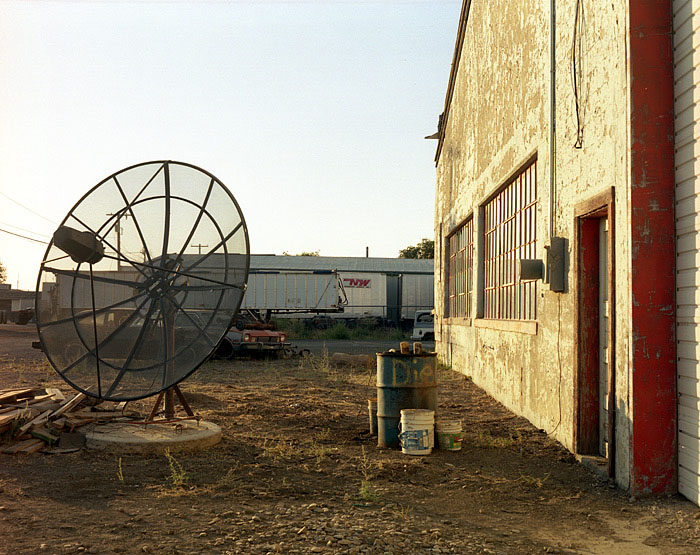 Die, Twin Falls, Idaho 1999